子方向1:多相流测量
集成静电、电容、压电、电涡流、声发射、图像及过程层析成像等多类型传感技术,融合人工智能算法,面向气/液、气/固、液/固等多相流流量、流速、相含率的测量,开展多模态计量与可视化成像方法研究,研制复杂流量智能检测仪表,研发适用于碳捕集、利用、封存链中的碳计量技术和建立相应的碳计量标准。
此外,研究电学层析成像的多相流参数传感机理与智能成像方法以及面向工程应用的多相流参数分布动态监测仪器,为低空—水下高速装备的全生命周期安全运行提供坚实的技术基础与测量保障。
子方向2:燃烧过程检测
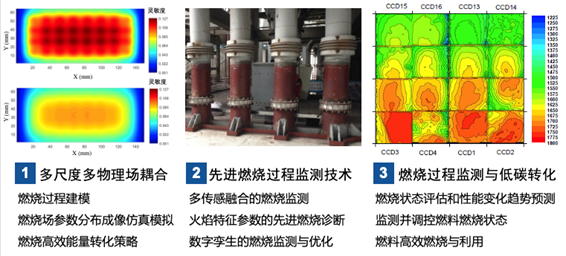
研究光学、图像、静电、电容、声发射等多类型传感技术,融合人工智能算法,实现对氢/氨/SAF/金属/生物质/煤粉/废料等燃料燃烧过程的实时检测,开展多模态传感与可视化成像方法研究,开展激光吸收光谱层析成像、激光拉曼/瑞利散射光谱、燃烧辐射场三维诊断等关键技术研究,实现航空发动机、液体火箭发动机、火力发电、冶金高炉等燃烧过程动态监测,为燃烧室性能优化、燃烧稳定性调控与故障溯源提供核心技术支撑。
子方向3:重大装备与结构无损检测
研发涡流、超声、漏磁等多种无损检测技术手段,实现多物理场协同检测与数据融合,应用于钢铁智能制造、风力发电叶片检测、氢能储运装备、长输管道及异型关键构件等领域。针对高性能非金属复合管道及输氢管道,开展复合材料结构健康监测技术研究。聚焦纤维复合材料宏微观结构性能表征与调控,开发具有损伤感知功能的复合管道,构建基于复合材料压阻传感特性的管道结构损伤监测技术。
子方向4:面向氢能系统及低碳场景的MEMS多参量原位传感与分布式监测
专注于MEMS/NEMS传感器设计与微纳制造(薄膜热电偶、电化学气体传感器等),集成到电解槽、燃料电池、热交换器等系统中实现原位监测。结合AI技术对温度、应力、应变、气体组分等参量进行数据分析,优化系统效率与稳定性。
子方向5:能源颗粒制备过程的多参数检测与数字孪生
聚焦能源颗粒材料的制备与调控,开展能源颗粒材料低碳智能制备过程关键技术开发和多参数原位测试技术,开展基于颗粒数值计算和数字孪生的应用基础研究和产业化探索应用。在新能源、化工生产等领域开展示范应用,助力行业的智能化升级。
Sub-direction 1: Multiphase Flow Measurement
Multiple sensing technologies including electrostatic, capacitive, piezoelectric, eddy current, acoustic emission, imaging and process tomography are integrated with artificial intelligence algorithms. Targeting the measurement of flow rate, flow velocity and phase fraction of gas-liquid, gas-solid, liquid-solid and other multiphase flows, research is carried out on multi-modal metrology and visualization imaging methods. Intelligent instruments for complex flow measurement are developed, alongside carbon metrology technologies applicable to the carbon capture, utilization and storage (CCUS) chain, and relevant carbon metrology standards are established.
In addition, investigations are conducted into the sensing mechanism of multiphase flow parameters and intelligent imaging methods for electrical tomography, as well as dynamically monitoring instruments for multiphase flow parameter distribution oriented to engineering applications. The research provides solid technical foundations and measurement guarantees for the full-lifecycle safe operation of high-speed low-altitude and underwater equipment.
Sub-direction 2: Combustion Process Detection
A variety of sensing technologies such as optical, imaging, electrostatic, capacitive and acoustic emission techniques are combined with artificial intelligence algorithms to realize real-time detection of combustion processes for fuels including hydrogen, ammonia, SAF, metal fuels, biomass, pulverized coal and waste materials. Research covers multi-modal sensing and visualization imaging methodologies, as well as key technologies such as laser absorption spectroscopy tomography, laser Raman/Rayleigh scattering spectroscopy, and three-dimensional diagnosis of combustion radiation fields. Dynamic monitoring of combustion processes in aero-engines, liquid rocket engines, thermal power plants, metallurgical blast furnaces and other facilities is achieved, offering core technical support for combustion chamber performance optimization, combustion stability regulation and fault tracing.
Sub-direction 3: Non-Destructive Testing for Major Equipment and Structures
Diverse non-destructive testing technologies such as eddy current, ultrasonic and magnetic flux leakage testing are developed to realize multi-physics collaborative detection and data fusion. These technologies are applied to fields including intelligent steel manufacturing, wind turbine blade inspection, hydrogen energy storage and transportation equipment, long-distance pipelines and special-shaped key components. Research on structural health monitoring of high-performance non-metallic composite pipelines and hydrogen transport pipelines is carried out. Focusing on the characterization and regulation of macro and micro structural properties of fiber-reinforced composites, composite pipelines with damage sensing capability are developed, and pipeline structural damage monitoring technologies based on the piezoresistive sensing properties of composite materials are established.
Sub-direction 4: MEMS Multi-Parameter In-situ Sensing and Distributed Monitoring for Hydrogen Energy Systems and Low-Carbon Scenarios
The research focuses on the design and micro-nano fabrication of MEMS/NEMS sensors (thin-film thermocouples, electrochemical gas sensors, etc.). These sensors are integrated into electrolyzers, fuel cells, heat exchangers and other systems to enable in-situ monitoring. Artificial intelligence is adopted to analyze parameters such as temperature, stress, strain and gas composition, so as to optimize system efficiency and operational stability.
Sub-direction 5: Multi-Parameter Detection and Digital Twin for Energy Particle Preparation Processes
Focusing on particle-related multiphase processes, including fluidized bed coating, granulation, and drying, this research aims to develop key technologies for low-carbon intelligent preparation, as well as multi-modality process tomography and online measurement techniques. Fundamental studies and industrial applications will be pursued based on CFD-DEM simulations and digital twin technology, targeting real industrial processes involving gas–particle flows.