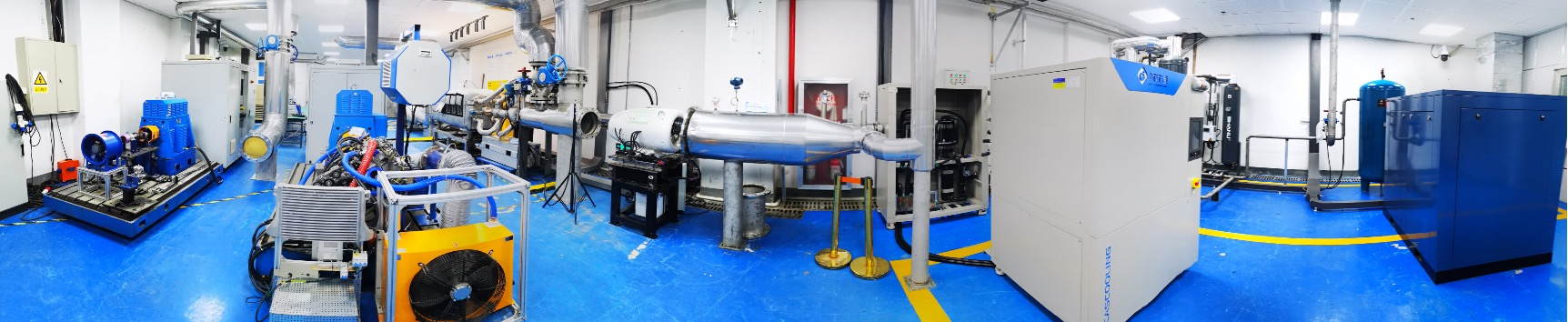
子方向1:航空发动机新燃料高效清洁燃烧与排放调控
面向空天动力,围绕SAF等新燃料的安全与减排需求,建立多源燃料理化特性数据库,揭示其燃烧火焰特征与化学反应机理;研究宽掺混比SAF在复杂高空条件下的供油、密封兼容及热端部件耐久性,提出油机安全适航边界与符合性验证方法;发展新燃料喷雾、点火、稳定燃烧及多污染物超低排放协同控制技术,同时结合全球飞行轨迹与气象数据构建航空排放大数据平台,运用智能算法揭示排放时空演化规律,为国际碳抵消机制提供支撑。
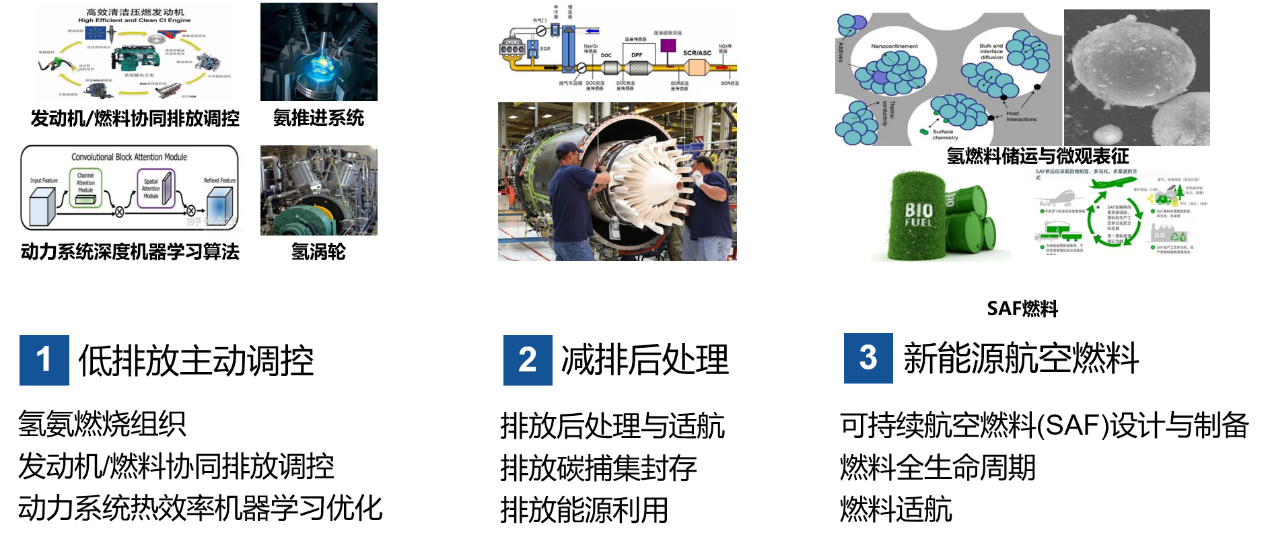
子方向2:航空排放精密测量仪器研发与适航测试
针对航空发动机全工况(含新燃料)排放特征,研制高灵敏度在线/离线检测仪器,覆盖气态污染物、超细颗粒物及非常规排放物种,提升高空条件下的测量精度与可靠性;完善适航标准的测试方法与校准体系,建立航空排放测试验证平台,为排放清单构建、减排效果评估及机载监测提供核心测量手段。
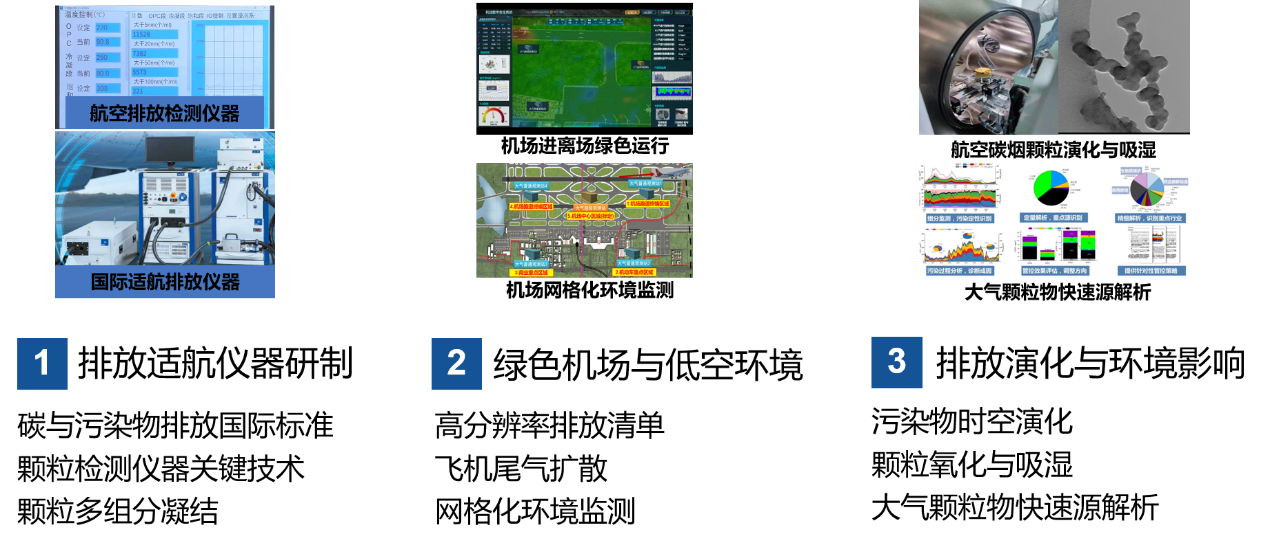
子方向3:航空排放的环境健康影响与高空气候效应
基于精密测量数据,构建多尺度全球排放清单与源解析,评估航空排放对机场周边人群暴露健康风险;同时阐明航空排放颗粒物生成演化与凝结尾迹形成机理,建立航空非二氧化碳气候效应量化评价方法;结合高空模拟实验获取新燃料高空排放特性,将数据融入气候模型评估不同减排路径的全球增温潜势,并构建集成燃料特性、适航安全、燃烧排放和气候效应的多尺度耦合方法,建设多型航空发动机新燃料示范验证平台。
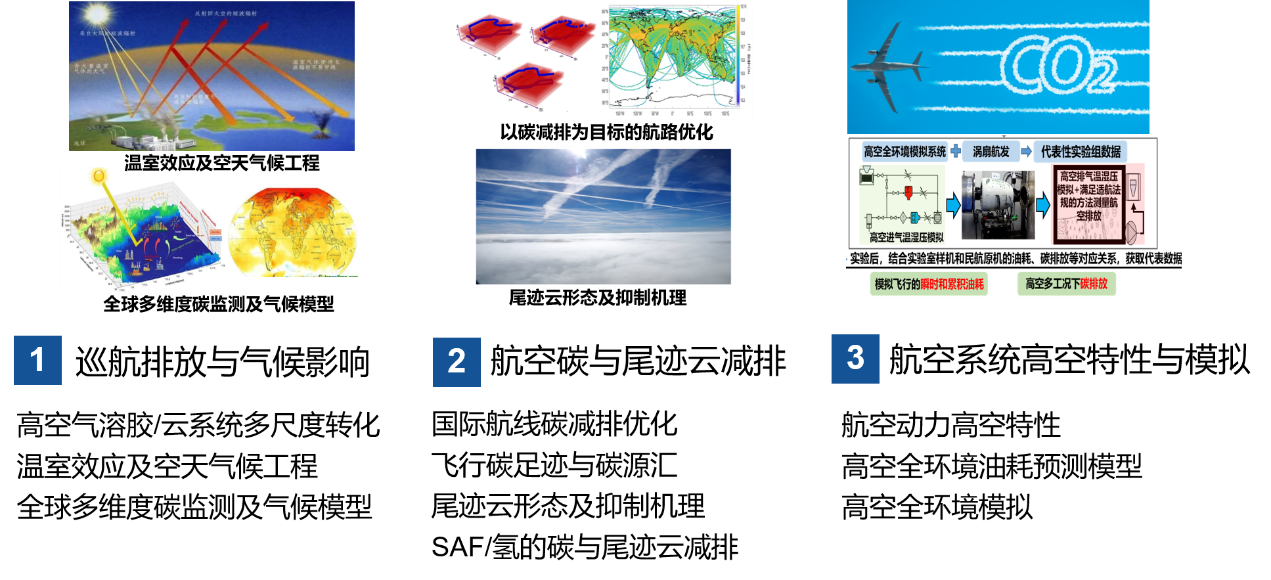
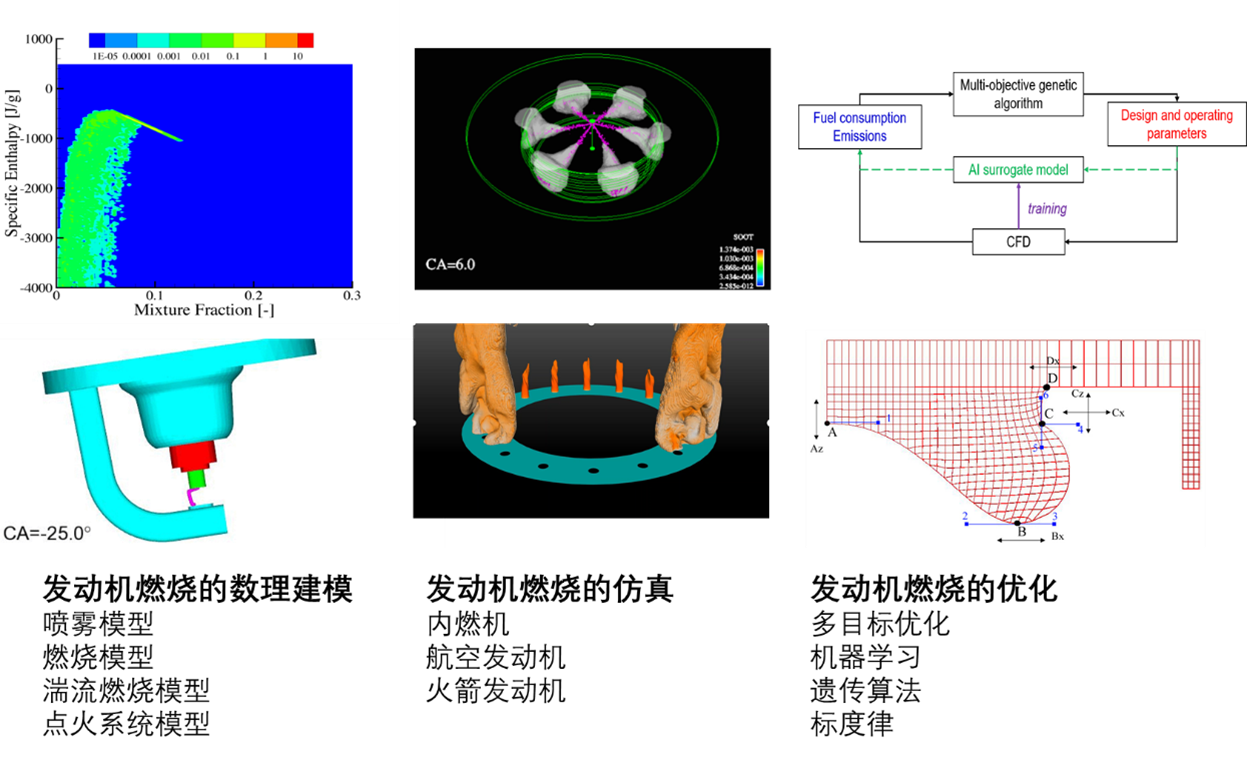
子方向4:发动机燃烧的数理建模、仿真与优化
开发适合工程计算的关于两相流、燃烧的数学物理模型;利用先进的仿真软件,研究发动机燃烧过程的物理机理;结合遗传算法、机器学习、CFD等方法,优化发动机的设计;制造工艺过程的数值仿真;高性能计算。
Sub-direction 1: Efficient and Clean Combustion and Emission Regulation of Novel Fuels for Aero-Engines
Targeting aerospace power systems and addressing the safety and emission reduction requirements of novel fuels such as Sustainable Aviation Fuels (SAF), a physicochemical property database for multi-source fuels will be established to reveal flame characteristics and chemical reaction mechanisms during combustion. Research will be carried out on fuel supply, sealing compatibility and durability of hot-end components for SAF with wide blending ratios under complex high-altitude conditions. Airworthiness safety boundaries and compliance verification methods for fuel-engine matching will be proposed. Technologies covering novel fuel atomization, ignition, stable combustion and coordinated ultra-low control of multiple pollutants will be developed. Meanwhile, a big data platform for aviation emissions will be constructed integrating global flight trajectories and meteorological data. Intelligent algorithms will be adopted to uncover the spatial-temporal evolution of emissions, providing support for international carbon offset mechanisms.
Sub-direction 2: Development of Precision Measuring Instruments and Airworthiness Tests for Aviation Emissions
Aiming at emission characteristics of aero-engines under full operating conditions (including novel fuels), high-sensitivity online/offline detection instruments will be developed to cover gaseous pollutants, ultrafine particles and unconventional emission species, improving measurement accuracy and reliability under high-altitude environments. Test methodologies and calibration systems for airworthiness standards will be refined, and an aviation emission test and verification platform will be set up, supplying core measurement tools for emission inventory establishment, emission reduction effect evaluation and onboard monitoring.
Sub-direction 3: Environmental Health Impacts and Upper Atmospheric Climate Effects of Aviation Emissions
On the basis of precise measurement data, multi-scale global emission inventories and source apportionment models will be built to assess human exposure and health risks around airports induced by aviation emissions. Furthermore, the formation and evolution of particulate matter as well as contrail generation mechanisms from aviation emissions will be clarified, and quantitative evaluation methods for non-carbon dioxide climate effects of aviation activities will be established. High-altitude simulation experiments will be conducted to acquire emission characteristics of novel fuels at cruising altitudes. The measured data will be incorporated into climate models to evaluate the global warming potential of various emission reduction pathways. A multi-scale coupling framework integrating fuel properties, airworthiness safety, combustion emissions and climate effects will be developed, and a demonstration and verification platform for novel fuels applicable to multiple types of aero-engines will be constructed.
Sub-direction 4: Mathematical Modeling, Simulation and Optimization of Engine Combustion
Mathematic and physical models of two-phase flow and combustion suitable for engineering computation will be developed. Advanced simulation software will be utilized to investigate the physical mechanisms underlying engine combustion processes. Engine design will be optimized by combining genetic algorithms, machine learning, computational fluid dynamics (CFD) and other approaches. Numerical simulation of manufacturing processes and high-performance computing will also be covered.