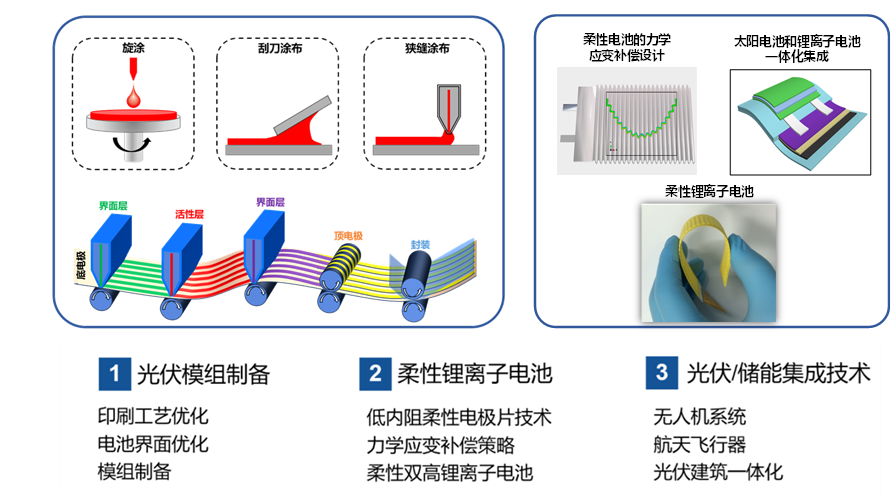
子方向1:光伏技术
聚焦于有机太阳能电池及钙钛矿太阳能电池两个主要研究方向,围绕新型光电材料的设计合成与表征、大面积光伏器件及模组的制备及构效关系研究开展系统工作。在材料层面,致力于开发高性能给体/受体材料、调控活性层形貌;在器件层面,攻关大面积均匀成膜、界面工程、封装技术等关键工艺;最终实现从实验室小面积器件向大面积组件的高效转化,推动有机、钙钛矿光伏技术的产业化进程。
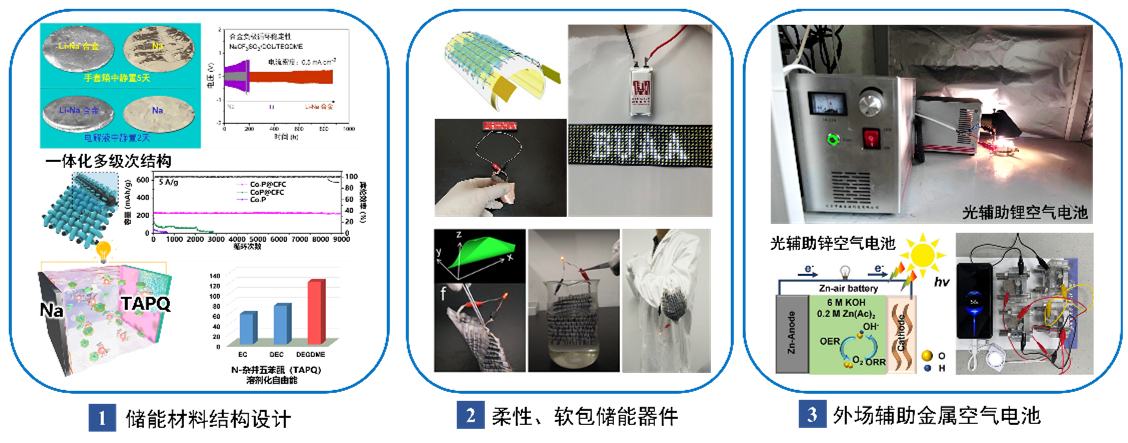
子方向2:储能技术
围绕金属空气电池相关材料,包括电极材料、催化剂、电解液等,进行设计合成和系统表征,并从组分和结构设计角度出发,结合主动学习策略,优化电极材料及电解质配方,结合理论计算和实验验证,最终实现材料的反向设计,加速高比能金属空气电池研发进程和专利转化运用。
子方向3:光伏与储能耦合技术
聚焦叠层器件和太阳能电池模组性能优化,以及与锂电池的集成工艺和电压管理系统的开发利用。重点突破光伏组件与储能电池之间的功率匹配、能量管理策略、系统效率优化等关键技术,开发面向分布式光伏+储能应用场景的集成解决方案与智能管理系统,实现光-储耦合系统的高效、稳定、智能化运行。
子方向4:能源化学
聚焦碳一化学与氢能源两个主要研究方向及其交叉应用研究。围绕传统石化能源和新能源体系,针对绿色石化-工业羰基化反应、氢能源化学的制取和存储设计制备催化剂、研发工业催化工艺。主要涉及烯烃高附加值利用、绿色塑化剂制备、高端多元醇酯基础油制备、化学储氢制氢等。
子方向5:环境化学
主要研究方向包括航空替代燃料(SAF)、生物质能转化与利用、能源利用与污染控制。研发固体废物处理处置与资源化、持久性有机污染物控制技术。例如:生物质热解焦油高品位转化和资源回收新技术开发,聚焦固体废物焚烧、金属冶炼等热过程二恶英全过程控制技术研发,以及上述工艺的工程放大与关键装备研发。
子方向6:电化学
聚焦电化学催化器件和性能优化。主要聚焦电化学催化二氧化碳捕获与利用、电化学催化合成中催化剂设计,法拉利效率提升、以及工业催化工艺开发。致力于破解电催化能源转化领域的关键科学问题,围绕“高效制氢—碳循环利用”这一能源变革核心链条,开展跨尺度催化剂设计与反应机制创新研究,重点解决催化剂“活性—稳定性—成本”协同优化难题。在电催化析氢反应、析氧反应以及CO2电还原反应领域,基于不同反应体系的催化特征,设计一系列结构可控、机理清晰的高效电催化策略,形成了“贵金属低量化—催化位点稳定化”的核心技术路径,系统解决催化剂活性—稳定性—成本难以协同优化的行业痛点,为构建“可再生能源驱动—绿色化学品合成”的碳中和闭环提供了理论支撑与技术储备。
Sub-direction 1: Photovoltaic Technology
Research focuses on organic solar cells and perovskite solar cells. Systematic investigations are carried out covering the design, synthesis and characterization of novel optoelectronic materials, as well as the fabrication and structure–property relationship of large-area photovoltaic devices and modules. At the material level, efforts are devoted to developing high-performance donor/acceptor materials and regulating the morphology of active layers. At the device level, key technologies including uniform large-area film formation, interface engineering and encapsulation techniques are tackled. The ultimate goal is to realize the efficient scaling up from lab-scale small-area devices to large-area modules, and advance the industrialization of organic and perovskite photovoltaic technologies.
Sub-direction 2: Energy Storage Technology
The research centers on the design, synthesis and systematic characterization of materials for metal–air batteries, including electrode materials, electrocatalysts and electrolytes. From the perspective of compositional and structural design, combined with active learning strategies, electrode materials and electrolyte formulations are optimized. Integrating theoretical calculations and experimental verification, inverse design of materials is achieved to accelerate the research and development of high-specific-energy metal–air batteries as well as the transformation and application of relevant patents.
Sub-direction 3: Integrated Photovoltaic and Energy Storage Technology
Research focuses on tandem devices, performance optimization of solar cell modules, together with the development of integration processes and voltage management systems for lithium batteries. Priority is given to breakthroughs in key technologies such as power matching between photovoltaic modules and energy storage batteries, energy management strategies and system efficiency optimization. Integrated solutions and intelligent management systems oriented to distributed photovoltaic+energy storage scenarios are developed to enable the efficient, stable and intelligent operation of coupled photovoltaic-energy storage systems.
Sub-direction 4: Energy Chemistry
The research focuses on carbon chemistry, hydrogen energy and their interdisciplinary applications. Targeting conventional fossil energy and new energy systems, catalysts are designed and manufactured, and industrial catalytic processes are developed for green petrochemical and industrial carbonylation reactions, as well as the production and storage of hydrogen energy. Relevant research covers high-value-added utilization of olefins, preparation of green plasticizers, synthesis of high-end polyol ester base stocks, chemical hydrogen storage and hydrogen production, etc.
Sub-direction 5: Environmental Chemistry
Main research areas include sustainable aviation fuel (SAF), conversion and utilization of biomass energy, energy utilization and pollution control. Research is conducted on the treatment, disposal and resource recovery of solid waste, as well as control technologies for persistent organic pollutants. Representative work includes the development of new technologies for high-value conversion and resource recovery of biomass pyrolysis tar, research on full-process dioxin control technologies in thermal processes such as solid waste incineration and metal smelting, alongside the engineering scale-up and key equipment development for the above processes.
Sub-direction 6: Electrochemistry
Research focuses on electrochemical catalytic devices and performance optimization. Priority is given to electrochemical catalytic CO₂ capture and utilization, catalyst design for electrochemical catalytic synthesis, Faradaic efficiency improvement and industrial catalytic process development. This work aims to address key scientific challenges in electrocatalytic energy conversion. Centered on the core energy transition chain of “efficient hydrogen production – carbon recycling”, cross-scale catalyst design and innovation of reaction mechanisms are explored, with emphasis on tackling the trade-off among catalyst activity, stability and cost. In the fields of electrocatalytic hydrogen evolution reaction, oxygen evolution reaction and CO₂ electroreduction reaction, a series of efficient electrocatalytic strategies with controllable structures and clarified mechanisms are designed according to the catalytic characteristics of different reaction systems. A core technical route featuring “low precious metal loading – stabilization of catalytic active sites” is established, systematically resolving the prevalent industrial bottleneck of difficult simultaneous optimization of catalyst activity, stability and cost. It provides theoretical support and technical reserves for building a carbon neutrality loop of “renewable energy-driven green chemical synthesis”.